
Be Authentic - Be Honest with Yourself and Examine Expectations from Others
Healing journeys provide opportunities to reexamine our authentic selves.

When we find ourselves in survival mode, stopping the spiral, or dealing with otherwise extreme life challenges, there is often a silver lining.
Sometimes those life-stages provide an opportunity to ‘reset’ our thinking through the healing process. When building a new framework, we have an opportunity to fine-tune authenticity … to better understand who we truly are … and to pave a more effective path toward seeking alignment.
The best ways I’ve found to do that are to be honest with myself and examine expectations from others.
On the road From War to Writing, we seek alignment as we rebuild along our healing journey.
We are far more likely to be effective at seeking alignment when we start with being authentic.
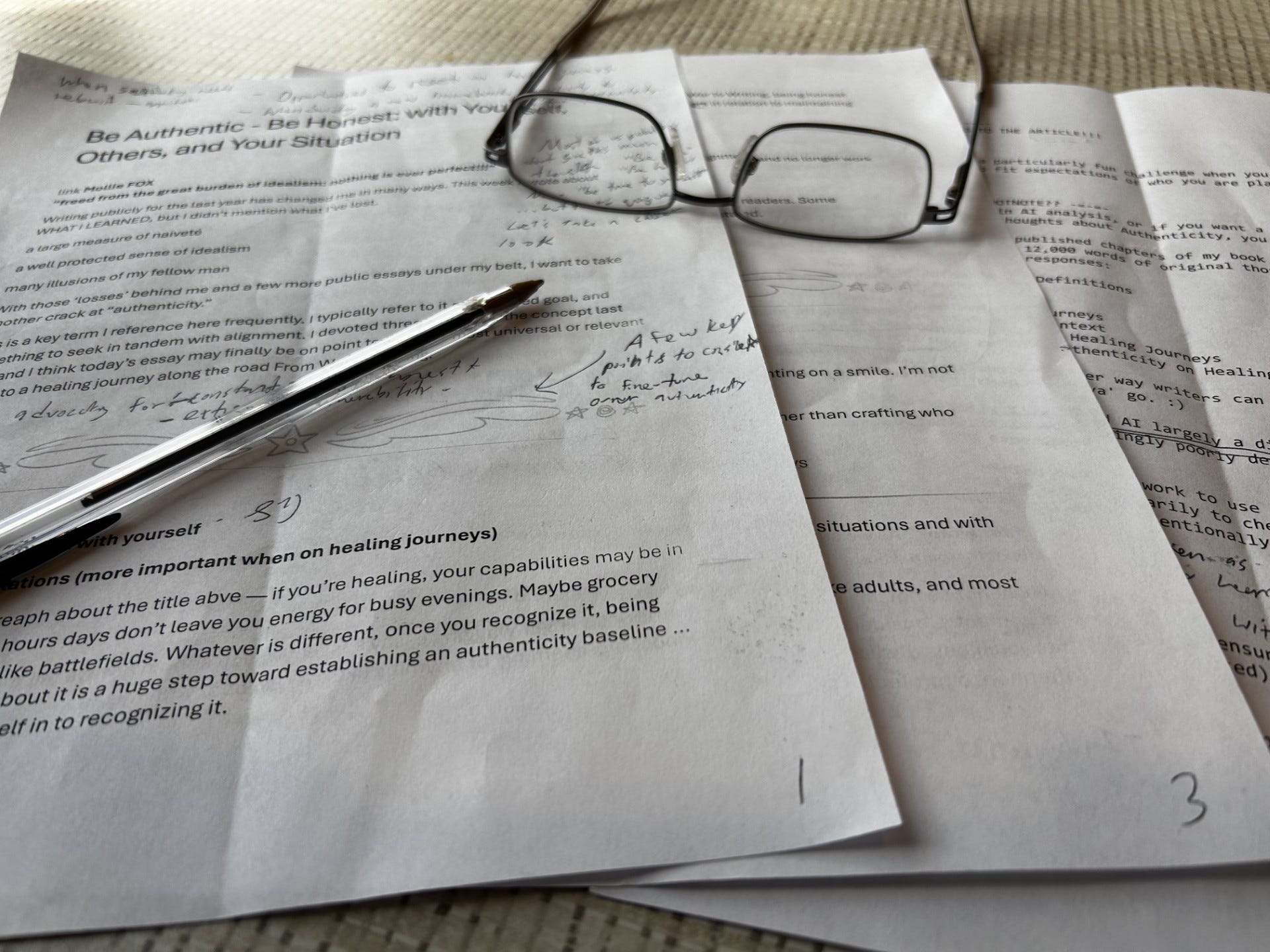
“Authenticity” is a key term referenced frequently in my writing here. It is typically referred to as a desired goal and something to seek in tandem with “alignment.” … but what is it?
What is Authenticity?
Most of us likely don’t give “authenticity” much thought. We may think it means:
“Be nice”
“Be honest”
“Be yourself”
But those don’t really hit the mark.
The most appropriate definition for today’s article comes from dictionary.com. It says authenticity means:
“Representing one’s true nature or beliefs; true to oneself or to the person identified.”
Authenticity means being true to yourself.
Okay, that’s neat… but Why should we seek authenticity?
We seek alignment on healing journeys… and that’s really hard to do well, unless we start with authenticity.
This is not a finger-wagging essay suggesting you should always tell the truth. I’m not condemning ‘little white lies’ or ‘Pinocchio-shaming’ or anything like that, so bear with me. ;p
I am NOT advocating for:
constant or brutal honesty
extreme vulnerability
crafting an ‘authentic persona’
Instead, this article will address ways to help fine-tune our perspective on what authenticity means to each of us personally.

Be Honest with Yourself
With the noise of the world and the demands of everyday modern life, it can be easy to lose ourselves in the chaos. Our obligations and responsibilities often leave little room for our ourselves or to ‘hear ourselves think.’ When we find ourselves in survival mode, it can be easy to lose sight of who we are. As we dig back out, establish our footing, and build a framework for healing, we find an uncommon opportunity to build with a fresh start based on our authentic selves.
… About Your Limitations
(particularly important on healing journeys)
If you’re healing, your capabilities may be in flux. Maybe those 9-hour days no longer leave you enough energy for busy evenings. Maybe grocery stores suddenly feel like battlefields. Whatever is different, once you recognize it, being honest with yourself about it is a huge step toward establishing an authenticity baseline … or at least getting pointed the right direction.
I came face to face with the reality of my limitations kicking and screaming. For my entire 24-year career, being healthy, capable, competent… lethal… was my job. My health was a core pillar of my identity and self-worth. After I retired, as my disabilities became more apparent, it took a while to realize how significantly different my life was now... and how differently it needed to be configured going forward.
The massive life change when I retired led to crafting an entirely different framework for daily life.
Coming to terms with how all of those changes impacted me — being honest with myself about it — was a humbling experience.
It also provided an excellent opportunity to reexamine my thoughts on what it means to be authentic.
To dig deeper on recognizing limitations on healing journeys:

Identify What Matters Most — to You
A great place to start when searching for Authenticity is to consider priorities:
Dandelions — ‘Let Your Dandelions Grow’ means: Don’t try to fix ‘everything.’ Ignore what you should. If something can wait, consider letting it wait, especially if it is a very low priority.
Big Rocks and Little Rocks — Identify high- and mid-level priorities. Take care of those first to avoid getting distracted by the dandelions.
Glass Balls — These are your no-fail missions.
As I gained clarity in those major categories, with some deliberate thought and being honest with myself, I found a feeling of authenticity I haven’t felt in a long time. Identifying your priorities should, by definition, lead to a better understanding what is truly most important to you. That leads to understanding your authentic self.
For more details, Chapter 1 of From War to Writing digs deeper on ways to identify and work with your most important priorities.


Examine Expectations from Others
Many expectations in our lives come from outside ourselves - from other people, traditions, or systems. Those external expectations often influence our ability to see our true selves and hinder our ability to be authentic.
Because of that, it’s important we examine expectations from others.
“Should-ing”
It is easy get in the habit of “should-ing ourselves” or doing things only “because we should.”
Any time I hear the word “should,” I think about authenticity. The world says we ‘should’ do (or think) many things, but how often do we stop to consider ‘why?’ It can be easy to lose our authentic selves when we’re always striving to do what others say we should do.
It is also easy to be too hard on ourselves when healing journeys impact our ability to do things we usually can do and think we ‘should’ still be able to do. When we recognize our shifting capabilities and capacities, and give ourselves a little grace, we lessen the blow of ‘should-ing.’
Finding our authentic selves and reclaiming personal agency often meet healthy friction with the word “should.”
Emotional Weight of Others
Being authentic can be a particular challenge when we’re used to contorting large parts of ourselves to fit expectations placed upon us by others.
One thing I’ve found on my journey and research is that unnecessarily carrying the burdens of others’ emotions can weigh heavily on us… particularly when recovering from trauma or going through any significant healing journey.
I’ve found that can also hinder our ability to be authentic.
This concept opens doors to entire areas of study, including Stoicism, but the point for today is to be aware of this possibility. When I first learned I might be allowing others’ emotions to override my own sense of self, it simply didn’t compute. But, as I learned to notice that happening, I was able to start recognizing my own self in the chaos of healing and begin to seek authenticity.
In a sense, when we ‘hold space’ for others, when we shouldn’t, or can’t, it can cloud our ability to see our authentic selves.
Bottom Line: You may be carrying the emotional weight of others, unnecessarily. That could impact your ability to be authentic.
To explore the nuance here, these articles dig deeper:


Non-Standard Deviations - Naps!
Naps aren’t just for kids. If you’re in a life transition or phase where you’re not in a ‘9-5’ every day and you can take a nap, consider giving yourself permission to take one occasionally. :) Naps obviously don’t fit well in ‘9-5s’ at the office… but who’s expectation is it that you don’t nap when you’re in charge of your schedule, or home on a weekend?
If napping isn’t your thing, consider applying this idea to taking deliberate breaks from your work to do something you enjoy. Maybe take a walk. The point isn’t about taking naps… it’s about claiming a part of your day to recharge … for something authentic instead of scripted. Non-Standard Deviations help us remember, or rediscover, our authentic selves.

Wrap
Though healing journeys bring many challenges, they also present opportunities to explore what it means to “be authentic.”
When we’re in or near survival mode, we get a front-row seat to recognize limits to our capabilities. That helps us determine what matters most to us, which naturally brings us more in-tune with our authentic selves.
Being honest with ourselves and examining expectations from others will put us on the road to being more authentic.
Finding clarity on who we are helps us pour a solid foundation for building aligned frameworks to support our healing journey.
Thank you for reading!
I hope you found some tips, tricks, or perspective today to help you be more authentic — in whatever way that is uniquely you.
Until next week, take care. :)
Yours, From War to Writing,
- Terry 8^)
What are your thoughts? Am I on to something here or am I off my rocker? I will gladly hold space for your comments. :)

If you would like to explore my previous thoughts on “authenticity,” the following articles cover the topic from a few different angles:


We create connection through authenticity.