
‘Holding Space’ - Addressing a Big Challenge on Healing Journeys
'Holding space' sounds simple, but is it?

When researching trauma and healing I see the phrase “Hold Space” everywhere, but the definition is generally missing or nebulous.
The often-vague references sound like ‘holding space’ should be easy and intuitive… like something we simply need gentle reminders to do at the right times.
But it’s not always that simple. It can be more complicated, particularly for anyone travelling a healing journey.
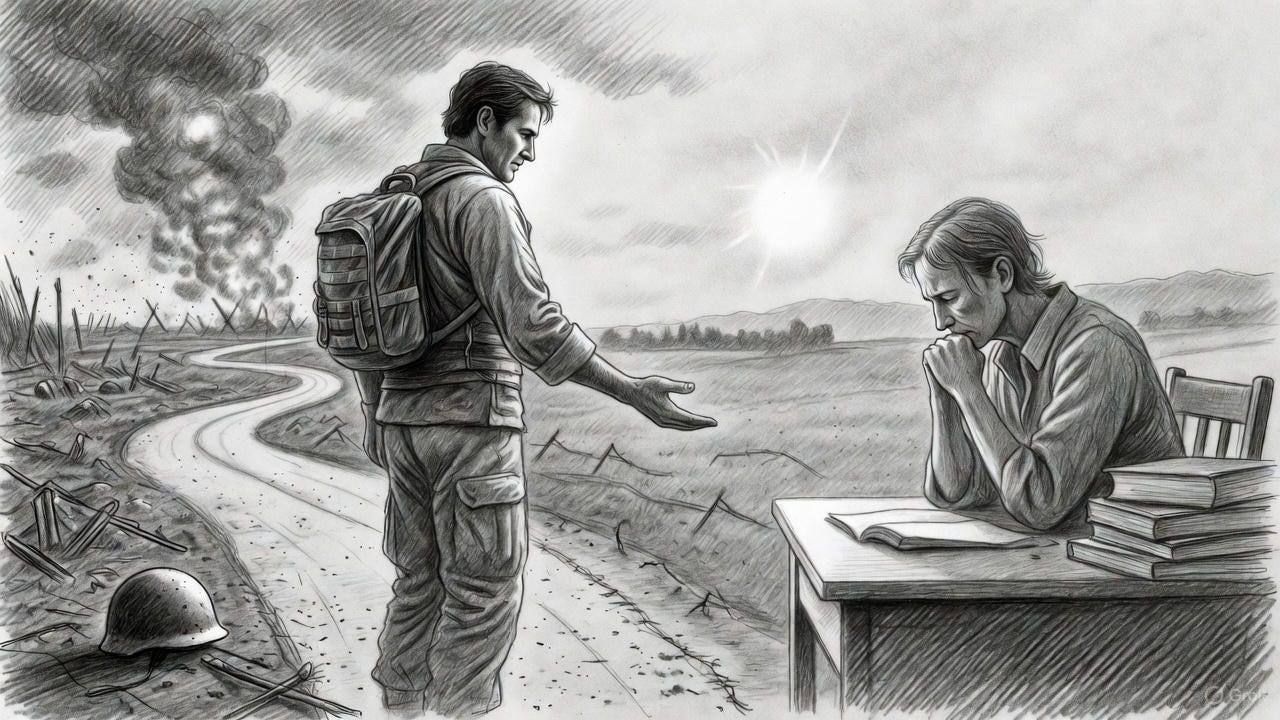
Over my career I never spent much time “healing” from anything. During a year spent tackling a significant health issue I was arguably more concerned about keeping my job than the process of getting better.
One thing I barely noticed, and didn’t fully appreciate at the time, was that I stopped ‘holding space’ for others in that season.
Fast forward 10 years, post-career, near the beginning of my healing journey, after stopping the spiral… I noticed the same feeling again. I wasn’t ‘holding space’ for others the way I wanted to … or as well as I thought I was.
I gained a new appreciation for just how much effort it can take to ‘hold space’ for others when we’re wrangling our own healing journeys.
Today I’ll share how I see this term through the lens of a healing journey along the road From War to Writing.
We’ll talk about what it means to ‘hold space.’ We’ll address some of the specific challenges to ‘holding space’ we encounter while on healing journeys. We’ll also touch on three things we can do to increase our effectiveness at ‘holding space.’

What does it mean to ‘Hold Space?’
In essence, ‘holding space’ means being a good listener.
When we do it well, holding space is a gift.
‘Holding space’ means actively focusing outside ourselves to understand the perspectives and concerns of others.
On its most simple level, ‘holding space’ means being present with someone and helping them feel seen and heard.
It entails active listening. It means understanding someone’s position/plight/struggle without trying to solve problems or force outcomes or solutions.
For those of us used to solving problems and fixing things, ‘holding space’ may not come naturally or easily. :)
Holding space also means:
Being an “active presence” — Much like being an ‘active listener’ means listening to absorb meaning, being an active presence means being actively aware of your surroundings - people and environment.
‘Sitting in Discomfort’ — Refraining from trying to ‘fix’ things may be the most challenging part of ‘holding space.’ Listening to and feeling the struggles of others, understanding their perspectives and being with them instead of trying to fix things for them, isn’t always easy.
On healing journeys, effectively ‘holding space’ can be a lofty goal. The professional ‘just do it’ mindset, pushing through, or ‘faking it’ might not work anymore. When rebuilding after stopping the spiral, we start with approachable things… like simply having genuine, pleasant conversations.
If we’re seeking alignment and authenticity, we may need to dig a little deeper than just painting smiles on our faces, because that may have been part of what got us on this road in the first place. :)

A Big Challenge to ‘Holding Space’ While Healing
One of the biggest challenges to ‘holding space’ while on healing journeys is the implication that we have the ability to devote brain bits to other people and their concerns.
In ‘typical,’ ‘normal,’ or ‘healthy’ daily life, that’s a reasonable expectation. That’s just daily life in society.
On healing journeys, that’s not always the case. Healing is hard work and at times may not leave us much ‘left over’ for others.
Our ability to ‘hold space’ generally increases when we are in healthier places ourselves. On healing journeys or other times of extreme stress or overwhelming situations, our ‘normal’ changes, and our capacity for holding space is often impacted.
“You can’t fill a cup that is already full.”
I heard this phrase used in a movie once when a mentor told a student they were ‘full’ of worry and didn’t have room for present concerns. As the old monk poured coffee and the cup overflowed, the young student worried only about the overflow and lost sight of everything else.
This metaphor seems to apply directly to healing journeys as well.
Healing journeys can be overwhelming. When we’re overwhelmed, we’re concerned about more things than we can handle. That can mean our cup is already full and we don’t have room to ‘hold space.’ All we can focus on is the overflow.

As we travel along our road, we heal, grow, and expand our horizons. Success eventually leads us to a bigger cup that doesn’t start each day already full, and a greater ability to ‘hold space’ for others.

How To ‘Hold Space’ More Effectively
A good first step to more effectively holding space is to identify the differences in approach between professional life and healing journeys.
Identify the Difference Between Our Professional Life and Healing Journey
The first step for holding space effectively on a healing journey is to recognize “just do it” isn’t the right answer.
This is a great example of where my current perspective departs greatly from the ‘advice’ I gave in my professional career just a few short years ago.
I used to think you could just compartmentalize your life’s concerns into a box and set it aside for a while. Like flipping a switch, I could ‘turn off’ everything else and just focus on ‘holding space’ for whatever task was at hand.
Now I know better.
‘Holding space’ is a skill, not a switch.
In the aircrew world, the general idea was that when it came time to fly you would “Leave your problems on the ground.” We needed to ‘hold space’ for our mission.
The Air Force did not care what was happening in your life. Once you stepped to the jet, none of that mattered. Only the mission did.
The idea was simple: If you can’t do your job, tap out.
Put another way: “Shut up and color.”
The WHY was clear: Mission first. Service Before Self.
HOW you got there was something they never taught. That was a rare case of a military expectation without clear instructions on how to accomplish the task.
While this mindset of ‘just do it’ may have been effective, perhaps even necessary in the military or other professional contexts, it is not the best technique to employ when travelling a healing journey.
Recognizing that ‘holding space’ is a skill and not a switch is an important step toward improving our ability to hold space and (re)connect with others.
Chapter 1 of From War to Writing digs deeper on addressing the specific changes in mindset from the professional perspective to the healing journey.
Empty Your Cup / Clear the Clutter
Another way to become more effective at holding space is to treat improving that skill as a goal or priority (big rock or little rock) to protect.
By placing the goal of ‘holding space’ within your active framework of healing, tools you already use compound in their effectiveness to ‘empty your cup’ and ‘clear the clutter.’
Chapters 1, 2, and 3 of From War to Writing point to different ways to do exactly that.
Chapter 1: Stop the Spiral — ‘Stopping the spiral’ is about addressing existential worry. In this stage we wake up every day with our cup already almost full. We’re trying to keep it from overflowing and making a mess. Holding space isn’t a realistic focus at this point and we should be seeking those who hold space for us. Our ability to hold space begins to improve as we accomplish this step.
Chapter 2: Protect Priorities — As we protect our priorities and define our battle lines, mental clutter becomes more manageable. Our cup stops overflowing when we take control over filling it.
Chapter 3: Seeking Alignment — With ‘holding space’ identified as a rock to prioritize, seeking alignment will include finding ways that work for you to hold space. It’s not a magic bullet, but it’s an effective process. If you find a situation where holding space isn’t working as well as you’d like, consider revisiting priorities to mentally prepare better or determine if that situation meets your alignment goals and warrants your focus or attention.
On the road From War to Writing, we build our ability to ‘hold space’ by protecting our priorities and seeking alignment. Our success in those areas, however we measure it, should directly tie to our ability to ‘hold space’ for others.
Seek Connection with Grace
Giving ourselves grace is a recurring theme here and is my final thought on how to ‘hold space.’
It is important to remember that our capacities and capabilities change and evolve, especially while on healing journeys. We should be seeking progress, not perfection.
Simply recognizing we want to improve our ability to ‘hold space’ for others is a big step in the right direction.

Wrap
Sometimes we need others to ‘hold space’ for us, particularly on healing journeys.
‘Holding Space’ is a skill, not a switch. Employing that skill looks a bit different on healing journeys than in our professional lives.
When we ‘empty our cup’ by protecting our priorities and seeking alignment, we increase our ability to ‘hold space’ for others.
Thank you for reading today, and in 2025!
This has been an incredible year of personal growth, and I thank you, dear reader, for coming along for the ride.
I wish you and yours the best in this new year!
See ya’ in 2026.
- Terry 8^)