
Reestablishing Boundaries: Protecting Our Time
How healthy boundaries around time reduce stress and help tackle anxiety and overwhelm.

The road From War to Writing is a journey… through stressful times aiming for more peaceful ones. Those roads look different for all of us, but for many here they involve tackling anxiety and overwhelm, specifically when facing major life change.
Today we begin a 3-part series on reestablishing boundaries. In this series I’ll share examples of how I’ve used boundaries to protect my priorities along my journey.
We will explore this through the lens of the PBA Framework: Setting Priorities, Managing Boundaries, and Seeking Alignment.
Today’s focus: Protecting Our Time
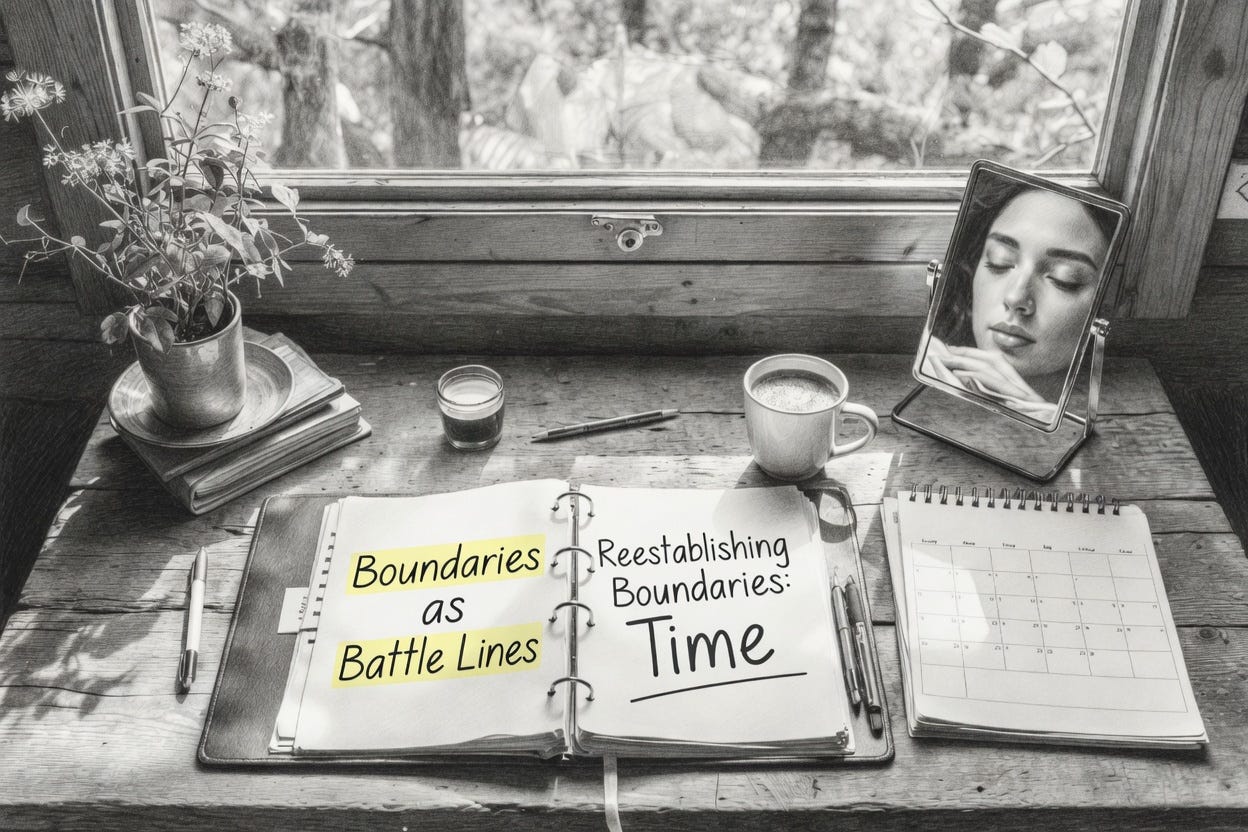
It is important to set healthy boundaries. When facing seasons of intense struggle, they become even more vital… and often more difficult to manage.
A key part of managing boundaries is to establish them in the first place. In crisis, we often face the need and opportunity to reestablish them.
When we’re in survival mode, our boundaries often face intense testing. Sometimes we find old boundaries that don’t work well anymore. Maybe some are no longer necessary. Often, a few could benefit from being reestablished or clarified. Doing so takes some work, or at least deserves a little time to consider our desired or most effective approach.
We’re not working magic. We’re slowing down to breathe and use our heads.
Today we’ll look at how the PBA Framework addresses boundaries, specifically when recovering from survival mode, and focused to protect our time, energy, and identity.
A recurring goal here is to craft boundaries that are sustainable and aligned.
In Chapter 2 of my memoir, I explained my approach to boundaries:
On the road From War to Writing, setting healthy boundaries can be like setting defensive battle lines:
They require strategy
We set them to protect our vital interests
We adjust them as the situation dictates
Boundaries are battle lines for survival, and we need to protect our time, energy, and identity.
Over the next few articles, we’ll focus on the final line of this quote and explore some of my discoveries. I’ll revisit a few things I chose to protect: my time by identifying dandelions, my energy so I could join a band, and a part of my identity by writing. We’ll also apply a few more lenses to provide additional perspective. With any luck, you can adapt a couple concepts for your own journey.

Why Protect Our Time?
I’ve learned that protecting my time is a key part of tackling anxiety and overwhelm. Perhaps that’s why all three aspects of the PBA Framework work together to help refine our approach to managing time.
In the military, I was told what to do with most of my time, most of the time.
In my career, when they did leave me alone, that precious time was spent scrambling to meet unmet needs and responsibilities in my personal life. What, if any time remained, was used to mount some form of personal physiological recovery before heading back into the fray.
Life is different now. Time requires a different approach. Without the military running the show, I have far more control over how I utilize mine. Learning how to wield those options effectively, however, while healing and seeking alignment, took a while to figure out.
As my journey progressed… as I healed more… I found balance. As the PBA Framework came together, clarity emerged.
Recovery is now deliberate instead of scraped together with leftovers. With anxiety and overwhelm tamped down, the need for recovery also reduced.
Managing effective boundaries around time made that possible.
Anxiety and Overwhelm / Benefits of the PBA Framework
When I reference anxiety, I’m talking about a feeling quite similar to being late for work. It’s the type that hits as a flash in your chest, sometimes radiating toward your wrists, as an instant, tangible, unignorable reminder of things that needed done already. Early in my healing journey, that feeling was all too common.
For a while, I barely recognized it for what it was because that level of heightened awareness had practically become my baseline. Protecting my time with the PBA framework allowed me to stave off waves of anxiety and overwhelm... and palpably lower my baseline stress level.
Success managing my time is where I often find the most noticeable relief.
The main goal, and one I found most elusive along my journey, was to improve (regain?) my ability to handle those flashes of anxiety and overwhelm in-the-moment, as they arrived. It took a while, but I got there. :)
In my research I found a common concept typically described as stepping back and looking at your emotions from the outside... seeing your emotions as something separate from yourself. It is approached many ways and seems like something supposedly fairly easy or simple to grasp… but every method I found fully escaped me.
Repeated application of the PBA Framework made it possible for me to metaphorically mentally step back in a way, just enough to reliably manage anxiety instead of being constantly overwhelmed by it.
Somehow, knowing my priorities, boundaries, and alignment were deliberately in sync provided a type of mental stability — like a solid framework should. Now I can rely on it to allow some measure of detachment in-the-moment when heightened emotions strike.
It’s not magic. It’s not fast. It’s not perfect… But it works.
Keep reading for specific examples of how I’ve learned to protect my time with the PBA Framework. :)
Yard Work - Dandelions
Trying to do too many things at once leads to both anxiety and overwhelm. When I embarked upon my healing journey, I had lost sight of proper time management. Yard work in particular caused an oddly significant amount of stress, and applying the PBA Framework helped take the edge off.
In this case, I set aside one day each weekend for yard work. This helped ensure it usually got done, but perhaps more importantly, it allowed me to not stress-out about doing the work on the other six days of the week. Early in my healing journey, fuzzy boundaries around time (and my unrecognized penchant for perfectionism) allowed dandelions to have far more power over me than I wanted. Tiny little weeds caused an outsized amount of anxiety. Then I developed the PBA Framework.
While I write this, I am literally letting my dandelions grow. Some yard work is piling up. I can see it out my office window. Remembering it needs to get done, and that I’m not doing it right now, still leads to mild anxiety spikes, but nothing like the crippling attacks that plagued me early in my healing journey.
Applying the PBA Framework to yard work helped make that healing possible:
Priority: Identified yard work as a task that can wait. Classified this task as a Dandelion.
Boundary: Set time for yard work: Sunday. Allowed ‘permission’ to ‘ignore’ it six days of the week. Reduced mental load and anxiety spikes. Helpful impact grew over time.
Alignment: Task was not urgent. Perfection was not the goal. Recognizing both helped.
Knowing I had prioritized the task and set healthy boundaries that were aligned with my goals and capabilities to accomplish it, allowed me to accept that the momentary anxiety was just an emotion to let pass. I had my bases covered; there was no need to get overwhelmed. Over time, that concept started to sink in.
In the case of yard work, waiting was aligned… even if it sometimes didn’t feel like it. Recognizing that was a huge step to reduce both anxiety and overwhelm.
A Note on Flexibility
Effectively managing boundaries around time helps ease stress, but on healing journeys, sometimes it’s not that simple.
When a planned or regular schedule doesn’t work for whatever reason… stress, commitments, bad weather, etc… we need to adjust.
We need to be flexible and actively protect our time.
With yard work, flexibility was allowed for weather or other plans. In part, this was possible because the work was, by definition, a dandelion: something that can wait.
When stress piles up, we should look for dandelions. I’ve been surprised to find how many things seem urgent, but really aren’t, when I examine my priorities.
Sometimes, tasks that can wait, should wait.
Driving My Daughter to School
Somewhere along my healing journey I recognized spending time with my daughter was particularly important to me. My bumpy journey added some tension to our relationship and her senior year of high school was on the horizon. When it became clear time was running short to repair our strained relationship before she left the nest, I needed to focus on protecting our rapidly dwindling daily opportunities to (re)connect.1
Before she got her license, driving her to school was a perfect opportunity. She could take the bus, but it saved her 45 minutes in the morning if someone took her in. It was serendipitous to find something that helped her and my goals at the same time… but actually doing it required some extra work on my part.
I chose to fight hard to protect those opportunities to strengthen our relationship. I was unwilling to accept the notion that my mental health struggles would drive a long-standing wedge between us, just before she left to start her own life.
Time was a key component of protecting this priority. Keeping a ‘standard’ daily schedule had become a significant challenge for me during a lengthy portion of my healing journey. Techniques I’d used my entire adult life all seemed to fail in different ways.
To protect this high priority, I needed to figure out how to keep my schedule straight.
The framework was key to provide the necessary structure and motivation.
How I applied the PBA Framework to driving my daughter to school:
Priority: Identified our relationship, therefore our morning drives, as a ‘task’ of high importance. Classified as a Big Rock. That goal became an anchor point for my daily schedule.
Boundary: Set time for proper rest. When many other efforts to regulate my sleep schedule failed, this big rock was enough motivation to get proper rest (keep a respectable bedtime) before our morning commute.
Alignment: Our relationship was important and time was waning to improve it. This seemingly small thing was within my capabilities … with a little solid effort. Recognizing this priority and setting appropriate boundaries formed an alignment that made our short drives together possible, and sustainable.
After applying the lens of the PBA Framework to my goal to (re)connect with my daughter in this simple way, things finally came together. It wasn’t quick or easy, but it worked.
Our short drives together over this last year have given us many opportunities to connect. Without a proper framework allowing for targeted use of my time, those moments may have been lost. Instead, we now share memories of foggy early mornings, expensive (but tasty) coffee and chai latte, and sunrises over the school parking lot talking about everything and nothing at the same time.
We set boundaries to protect our vital interests.
Wrap
As I’ve written before: I am not a ‘guru.’ I don’t have ‘all the answers.’
I share my story and what I’ve learned with the goal that it might provide some measure of hope and healing.
If you’re struggling with overwhelm, anxiety, PTSD, or major life change, I hope you find something here that you can apply in your life to make your journey just a little easier or a bit more fulfilling.
I wish you the best on your journey and look forward to sharing more insight soon. If you have questions or thoughts you’d like to share, feel free to send me a DM or leave a comment below.
Thank you for being here.
Until next Saturday, I wish you a pleasant week.
Yours, from war to writing,
- Terry 8^)
This article was written 100% ‘by hand’ with zero AI assistance. AI was used to generate the cover image. My AI Policy, Perspective, and Practice
Driving my daughter to school allowed me to spend a few minutes each day chatting with her…. or not, depending on the day. :) Regardless, it allowed us to maintain and slowly revitalize a connection that had weakened, particularly due to my PTSD struggles.
If you’re curious about my early thoughts on connection — this is a good example of the ‘connection feedback loop’ in an early speculative missive I wrote about The Empathy Tank.