
Tackling Overwhelm with the PBA Framework
Not a 'quick fix - A Robust Framework for the road ahead

Over my 24-year military career I built a robust framework for my daily life so I could live my professional life to the best of my ability.
When I retired, its collapse left me chronically overwhelmed and scrambling to rebuild something new.
That new life-scaffolding had to be different.
It is.
I call it the “PBA Framework” - Priorities, Boundaries, Alignment
It directly helps tackle overwhelm, can be adapted for many applications along different healing journeys, and has become my go-to technique for everything from stopping negative mental spirals to doing the dishes.
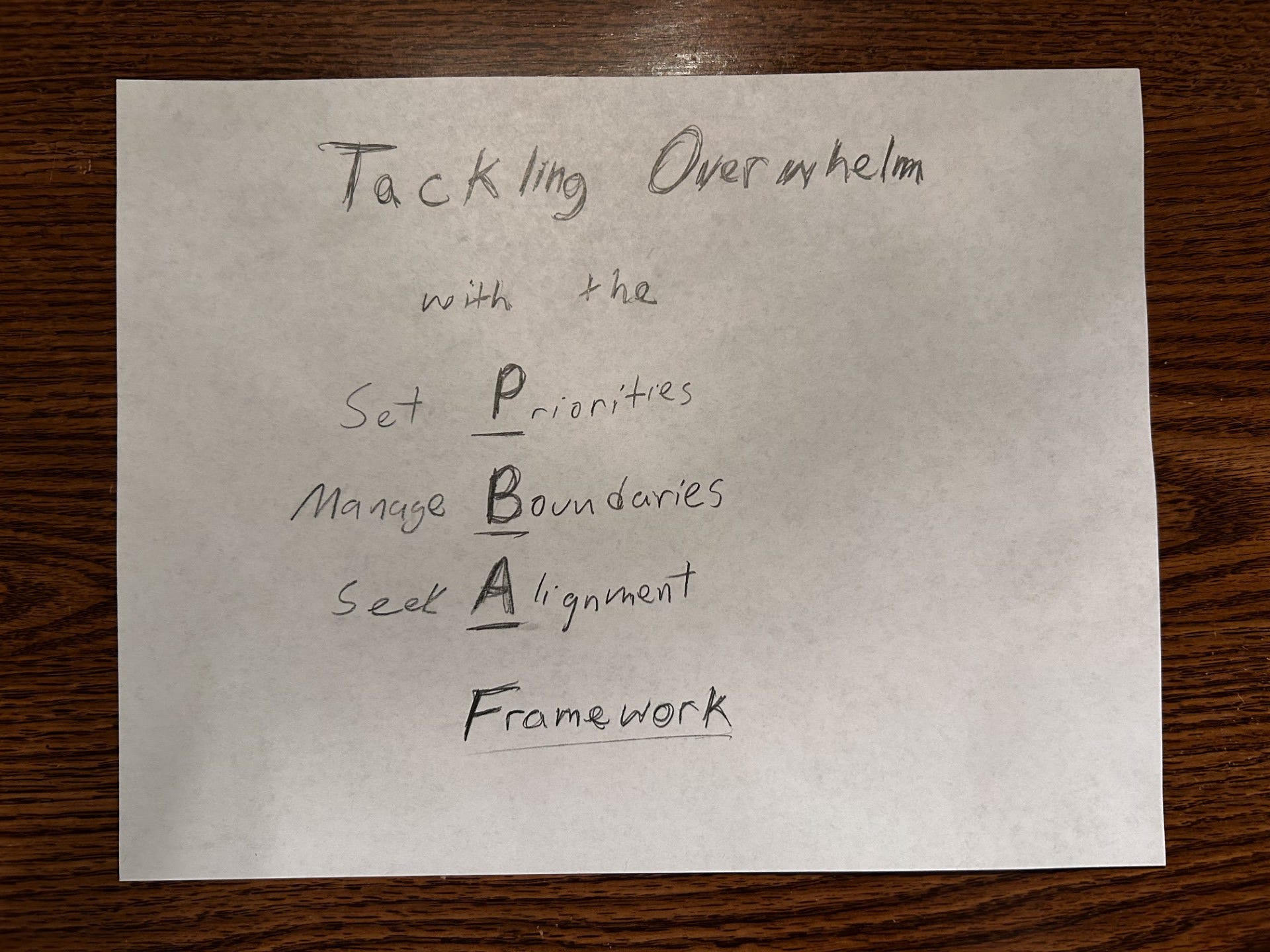
Over the year I’ve spent writing here I’ve learned many things and written about many mental health related issues from several angles. Now I’m using the PBA framework as a way to bring these thoughts together.
The idea is to take real challenges commonly found on healing journeys and apply the framework to help find and implement real solutions.
In From Boundaries to Breakthroughs, I mentioned I’ve already given you the framework… but it is spread out over three book chapters and a dozen different articles. Today I’m trying to capture the essence of the framework and make it useful, understandable, and approachable.
The PBA Framework is part process and part structure. As we repeat the process of setting priorities, managing boundaries, and seeking alignment, we’re not just tackling challenges as they arise — we’re building a system to tackle future challenges as well.
Overwhelm was the first thing I had to tackle, and it started with My First Attempt at Solitude.
Today, we’ll apply the PBA Framework to tackling “Overwhelm.”

Set (P)riorities
The first pillar in the PBA Framework helps us figure out what truly matters. This is the starting point for tackling overwhelm where we pause to sort through the chaos and decide what deserves our time, energy, and focus.
In crisis, setting priorities is one way to hit the brakes on a downward spiral by identifying what is truly essential versus what can, or should wait.
“When life gets intense, and pushes (or exceeds) our limits daily, finding footing can become our most elusive, yet most important goal.”
- Chapter 1: Stop the Spiral
The first time we deliberately focus on setting priorities, it might be a little messy or uncomfortable … but that’s okay.
Go at your pace. Focus on your goals.
Your priorities “list” won’t be “perfect” - certainly not the first time through. It will also evolve as life evolves. The initial goal is to identify what priorities matter most, not to sort every priority in your life. We’re looking for a place to start.
We will adjust each time we come back here after seeking alignment.
Here are some key factors to consider when Setting Priorities:
(additional ADHD tip in footnote1)
Recognize Dandelions (Things that can wait)
When struggling with overwhelm, I learned that not everything I thought needed immediate attention actually did.
When my therapist said, “I let my dandelions grow,” I realized that small stuff, like weeds in the yard or other minor chores, can usually wait. Trying to do ‘everything all the time’ wasn’t healthy, or sustainable.
That mindset shift freed up mental space when overwhelmed. It helped me shift from treating every task as urgent to focusing on the actually important ones.
Sort Priorities - Big Rocks, Little Rocks, and Sand
After identifying the dandelions, the metaphor of ‘Big Rocks, Little Rocks, and Sand’ can be used to help visualize tasks of varying importance.
Picture your priorities as rocks and sand you want to fit into a jar.
First, fill your “jar” with big rocks. These are core priorities like family, health, or a job. We can only realistically sustain focus on so many of these at time, so care should be taken on what goes here.
Next, add smaller rocks - the daily tasks that are important, but not urgent.
Finally, pour in the sand — the fun stuff or lower priority things that are ‘nice to do.’
When sorted this way, the rigors of daily life tend to become more manageable, and help tackle overwhelm.
Be Mindful of Glass Balls
The concept of “Glass Balls versus Rubber Balls” is the final prioritization technique I found effective along my journey.
Glass balls are priorities that are fragile and can ‘break.’ Urgent items that have real consequences if not addressed adequately and in a timely manner fall in this category. Think: getting to work on time or ‘holding space’ for someone close in a time of need.
Rubber balls are everything else.
The idea is to catch the fragile ones (non-negotiables) right away and let the rubber ones (flexible items) bounce … because you can catch them later.
For more on sorting priorities, I cover this concept in detail in Chapter 1 - Stop the Spiral

Manage (B)oundaries
Once priorities are set, this pillar protects them. Tips for setting boundaries are everywhere, but here, we focus on managing boundaries. We don’t simply ‘set’ them once and consider the job finished.
“On the road From War to Writing, healthy boundaries are like defensive battle lines: they require strategy, occasionally shift, and don’t always last forever.”
- Chapter 2: Protecting Priorities - Boundaries as Battle Lines
Boundaries are battle lines for survival used to protect our time, energy, and identity.
Note: When setting boundaries, they should be firm and clear. Managing them is the process of crafting them with future flexibility to evolve as needs change.
Let the Kite Strings Go (Stoicism)
Don’t allow yourself to be controlled by things outside your control.
Even a strong warrior will be carried away by the wind if he refuses to let go of kite strings in a gale.
This is the single most relevant perspective I’ve gained from my Stoicism research. Once I started setting boundaries, I was shocked to see how often I was trying to “protect” or hold-on-to things that were out of my control.
If you find a boundary isn’t working as intended, consider if it is designed to affect things you can control. If you’re tackling overwhelm, there might be gold in this particular area.
(For a list of things outside our control, and tips to handle them: 15 Things You Can’t Control and What You Can Control Instead (Free Printable!) - Tiny Buddha)
Recognize Your Limits
When facing chronic overwhelm our limits are often, if not constantly pushed. That can lead to us acting outside our healthy range without even realizing it.
It is easy to underestimate the mental energy we expend when under heavy stress. If you notice things that should or used to be simple or easy are now difficult, you may be finding a new limit.
When you recognize limits, you can manage boundaries as needed to keep them effective.
Thought-Spiral Tip: When I notice overwhelm begin, I sometimes use this mantra: “Big Rocks, Terry… Big Rocks…” With my big rocks identified and aligned, this helps keep me grounded in moments of chaos.
Manage Expectations
Remember: it’s okay to ask for help.
If you are used to handling ‘everything’ by yourself… being the go-to person for ‘getting things done’… you may be surrounded by expectations that require management. :)
If you recognize a limit - perhaps a new one for you - you can respect it by managing expectations. That may mean simply asking for help with a task others typically expect you to do. It may also mean adjusting your boundaries, so you don’t fight the same limitation every time.
For more detail on managing expectations, I wrote about an experience with doing the dishes, here:

Temporary and Adjustable
Not all boundaries are walls to hide behind forever; many are flexible guardrails that evolve as we do.
While many should be, not all boundaries are permanent.
As I wrote about earlier, in my social media break I set firm lines to step away completely, treating it as a dandelion to ignore. But as healing progressed, I waded back in with escape hatches in place.
The process of managing boundaries is about drawing lines to safeguard our peace, whether from people, habits, or stressors, so we can focus on recovery. As our healing journeys evolve, some of our boundaries might also evolve.

Seek (A)lignment
This final pillar ties the framework together.
In the alignment phase we assess how well our priorities and boundaries worked and how we can adjust the next time through the PBA framework to make them more effective.
The key here is to make the positive adjustments along your healing journey more sustainable. Not every priority or boundary adjustment will work exactly as intended the first time we try.
(And remember: “Healing isn’t linear.” Not every step will be a step forward.)
Seeking alignment is how we dial in our effectiveness.
“Seeking Alignment means building your life around who you are rather than crafting who you are around your life.
It’s not quick or easy, but it’s a rewarding pursuit.”
Here are some key factors to consider when Seeking Alignment:
Make an Honest Assessment
Alignment starts with an honest assessment. Be honest with yourself and determine if your actions match your values.
Note: There are no “right” or wrong” answers — just your assessment, for your use.
Questions to consider:
Where can I adjust my priorities to reduce overwhelm or reduce friction?
Can some big rocks be little rocks, sand, or dandelions?
Are my highest priorities actually mine? My responsibility? My duty? My choice?
How can my boundaries be more effective and aligned?
Did I exclude anything (or anyone) unintentionally?
Am I ready to place or enforce a boundary where I’ve been hesitant to act?
Are the boundaries I set realistically sustainable?
In practice, how well did my priorities and boundaries align?
With each other?
With my values?
With my goals?
It’s important here to be honest — but to also give yourself a little grace.2
Sustain Growth
We seek alignment to maintain momentum, sustain growth, and stay on a healing trajectory. This is where we strive to keep doing what is working and adjust things that aren’t.
After you’ve made an honest assessment of how your priorities and boundaries worked, give some thought to any specific things that hinder your progress. If you identify something to improve, focus on that next time you Set Priorities and Manage Boundaries.
Take Small, Practical Steps
Recognize your limits.
Consider feedback.
Make incremental changes.
Listen to your nervous system for cues.
On healing journeys, many practical steps are small. Minor adjustments compound over time. Each move you make toward seeking alignment builds on your previous course adjustment.
Tackling overwhelm does not come with an immediate ‘fix.’ Progress is made by adjusting priorities and/or boundaries one step at time, focused toward building a robust, sustainable, and effective framework.
Always remember: we’re seeking progress, not perfection.

Wrap
For many things, simply taking a few minutes to slow down and invest deliberate focus can solve problems or illuminate hidden paths with surprising effectiveness. That is the core design goal of the PBA Framework.
Once you’ve run through the framework, you’re ready to go through it again.
As I said above, the PBA Framework is part process and part structure. As we repeat the process of setting priorities, managing boundaries, and seeking alignment, we’re not just tackling challenges as they arise — we’re building a system to more effectively tackle future challenges as well.
Each time through the PBA Framework brings more clarity.
Alignment compounds over time.
If you chose to implement some of all of this framework, I hope it does as much for you as it has for me!
Until next Saturday, I wish you a pleasant week.
Yours, from war to writing,
- Terry 8^)

If something is confusing or if it seems I left something out or disconnected, let me know! I am happy to help make this framework more accessible and useful for you. :)
ADHD Priority Setting Tip
Setting priorities is more than just planning. Actively remembering previously set priorities when you recognize overwhelm strikes can help stave off being overrun. We tend to make better decisions, certainly strategic ones, when we’re calm.
After searching for over a year, I determined the “root cause” of my overwhelm is almost always agency or personal choice. Either dealing with an unwanted loss of choice or struggling to figure out how to adapt to ‘too much’ choice.
I was overwhelmed not because I wanted to do too many things, or that there were too many restrictions... it was that I hadn’t prioritized what truly mattered to me. I was getting spun up about things I “should” do or things I “needed” to do based on self-imposed requirements that were outdated or simply not mine.
In moments of extreme overwhelm (likely fueled in part by ADHD) I found it much easier to refocus and stay on track when I had clear priorities to remember.
Giving Yourself Grace
For example, when I first stopped the spiral, I noticed a big misalignment. When I took my first attempt at solitude and initially faced overwhelm head-on, I set priorities and boundaries so aggressively that my world got very, very small.
I realized my family landed outside my battle lines. While that may have been temporarily necessary to stop the spiral and survive, it wasn’t healthy, sustainable, or aligned with my honest priorities.
I ‘fixed the glitch’ when I focused my attention on seeking alignment and adjusted my priorities and boundaries accordingly.
This is a pretty significant example, but I use it to illustrate the point that the alignment phase can be used to correct even big things we get “wrong” on the first go-around.